From the desk of Dr. Derek Tow
"If my wisdom teeth don't hurt, I can just leave them alone." We hear some version of this almost every week, and it's an understandable way to think. Most of us are taught to see a doctor when something hurts, so when nothing hurts, it feels like there's nothing to do. But when it comes to wisdom teeth, no pain does not always mean no problem.
Many wisdom teeth that cause no symptoms are still quietly working against your long-term oral health. Some are buried deep in the jawbone, where you'd never see or feel what's happening. That's why we encourage young adults to have their wisdom teeth evaluated, even when everything seems fine.
At Los Angeles Oral and Facial Surgery in Beverly Hills, Dr. Derek Tow sees the outcomes of both approaches: patients who addressed their wisdom teeth early and sailed through recovery, and patients who waited and faced bigger problems later. Here's what we want you to know about the risks of leaving impacted wisdom teeth unaddressed, and why the timing of your decision matters more than most people realize.
Why So Many Wisdom Teeth Become Impacted
To understand the risks, it helps to understand why wisdom teeth cause trouble in the first place. Our jaws are not as long as those of our ancestors. Over time, human jaws have become smaller, but wisdom teeth are still part of our genetic blueprint. The result is a simple lack of space.
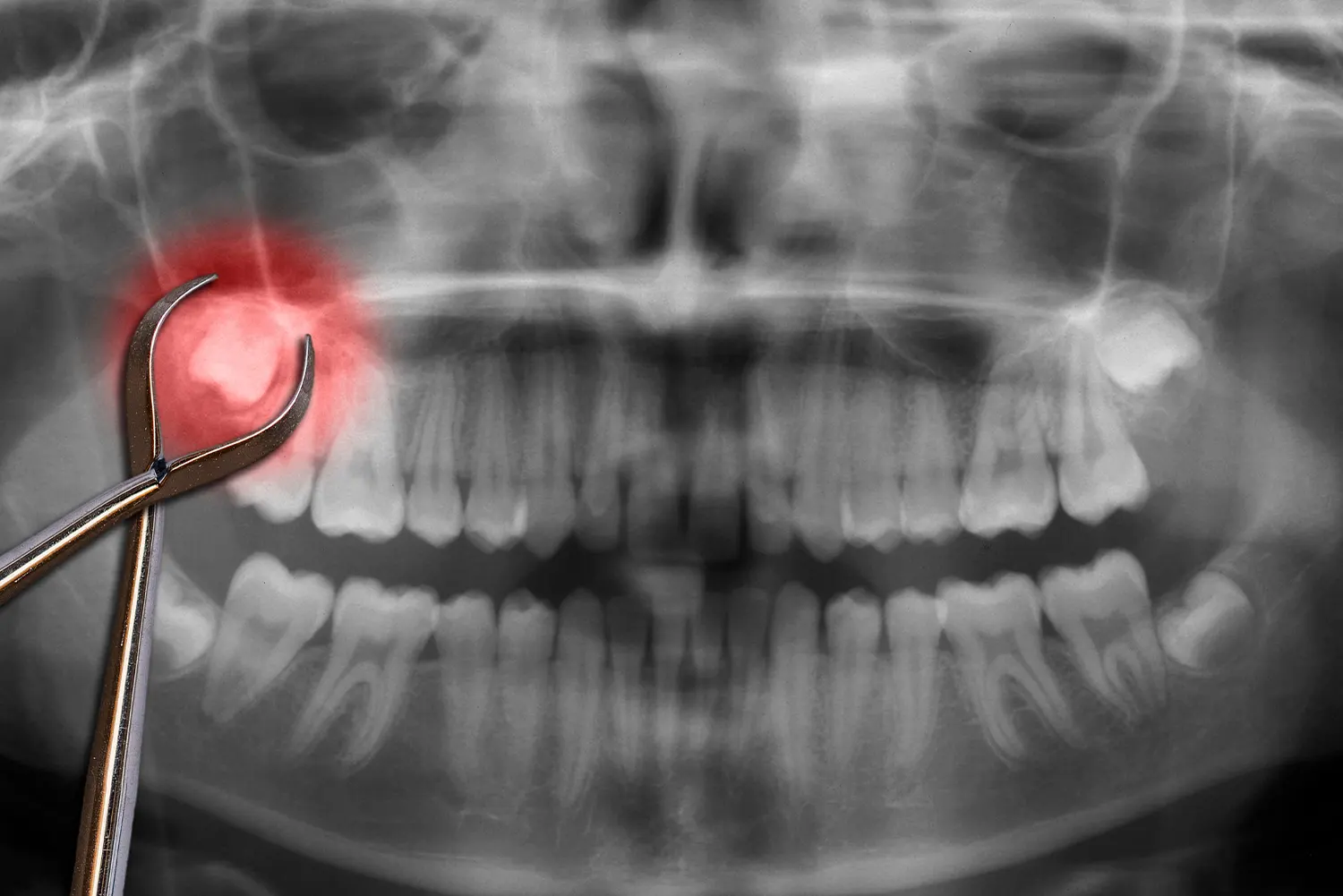
When wisdom teeth start to grow in, there often isn't enough room in the jaw to accommodate them. Instead of erupting normally into the mouth, they become impacted, which means they remain trapped and buried within the bone of the jaw. Some are tilted, some are stuck sideways, and some stay completely hidden beneath the surface.
Because impacted teeth are hidden, they can't be judged by how they feel or how they look in the mirror. This is why a thorough evaluation matters. A surgeon needs to carefully analyze your imaging and perform a physical exam to understand exactly where each tooth sits and whether there are vital structures nearby. Taking out wisdom teeth safely means knowing what surrounds them before the first step is ever taken, so that no permanent damage is done along the way.
The Hidden Risks of Leaving Impacted Wisdom Teeth Alone
When wisdom teeth are left untreated, they can lead to a surprising number of problems. Many of them develop slowly and without warning, which is exactly why they catch people off guard.
Cavities you can't see or feel. Even a small portion of a wisdom tooth peeking through the gums can develop a cavity. The back of the mouth is one of the hardest places to clean well, no matter how diligent you are with brushing and flossing. A toothbrush simply can't reach those areas easily. As a result, decay can build up unnoticed, and many patients don't realize anything is wrong until the problem has grown into something painful and much harder to treat.
Food impaction. When a wisdom tooth is only partly erupted or tucked up against the tooth in front of it, food can get trapped in spaces that are difficult to clean. Over time, that trapped debris contributes to decay and gum problems in the area.
Risk to the neighboring tooth. Your second molar, the tooth right next to the wisdom tooth, often pays the price. Over time, that tooth can be put at risk by the presence of an impacted wisdom tooth beside it. Saving a healthy neighboring tooth is one of the most common reasons we recommend removing wisdom teeth before trouble starts.
Cysts and tumors. This is the risk that surprises people most. Over time, impacted wisdom teeth can form pathologies such as cysts and tumors. These changes often don't show up until later in life, and they rarely announce themselves early. By the time they're discovered, the situation can be a much bigger deal than it would have been if the teeth had been taken out when you were younger.
Taken together, these risks explain why we don't think of "wait and see" as a neutral choice. Waiting is a decision with its own set of possible consequences.
Why Young Adults Are the Ideal Candidates for Removal
If wisdom teeth are likely to need attention at some point, the next question is when. The ideal window for removal is generally between the ages of 16 and 25. There are good reasons for that.
In your late teens and early 20s, wisdom teeth tend to be not fully formed. Teeth that are still developing are typically easier to remove. On top of that, this is usually the time in life when you are at your healthiest, which makes a real difference in how your body handles surgery and healing. A combination of teeth that are relatively easier to extract and a body that recovers well gives you the best chance at a smooth experience with the fewest complications.
Recovery time is one of the biggest differences. For a young, healthy patient, recovery after wisdom teeth removal is often just two to three days. For someone who waits until their 50s, that same recovery can stretch to three or four weeks. The older we get, the longer it takes to heal, and that's a trade-off worth thinking about when you're deciding whether to put this off.
There's also research suggesting that removing wisdom teeth before the age of 25 reduces the chance of complications by a significant margin. Those complications can include sinus issues and nerve damage, two things every patient wants to avoid. Which brings us to the next topic.
Protecting Vital Structures: Sinuses and Nerves
Your jaws contain important structures that a surgeon must respect. Understanding them helps explain why careful planning and the right timing are so valuable.
The upper jaw and the maxillary sinus. Behind your cheeks, above your upper teeth, sits a hollow space called the maxillary sinus. When upper wisdom teeth are removed, there is a chance that a connection can form between that sinus and the mouth. Knowing about this possibility in advance is half the battle. This is where 3D imaging becomes so important. It helps us decide whether the teeth should come out and shows us what we can do ahead of time to prevent these kinds of complications.
The lower jaw and the nerve to your chin and lips. In the lower jaw, a nerve provides sensation to your chin and lips. Impacted lower wisdom teeth are often very close to this nerve. If a tooth sits too near it, removal carries a risk of permanent numbness in those areas. Careful imaging and a thorough exam allow us to understand that relationship before treatment, so you can make an informed decision.
The takeaway is not meant to be frightening. It's the opposite. The more we know about where your teeth sit, the better we can plan. And the research points in the same direction as our experience: the younger you are when the teeth come out, the lower the risk tends to be.
What to Expect at a Wisdom Teeth Evaluation
If you're a young adult and your dentist has mentioned your wisdom teeth, but you aren't sure whether you want to have them removed, the best next step is simply to talk with someone who does this day in and day out. A local oral surgeon can take the right x-rays, perform a physical exam, and answer your questions based on what is actually happening in your mouth.
An evaluation is not a commitment to surgery. It's a conversation. Dr. Tow is happy to go over the reasons why you may or may not need your wisdom teeth removed, and he'll walk you through what he sees. Some patients leave with a plan for treatment, and others leave with peace of mind and a clearer idea of what to watch for.
It's also worth knowing that an evaluation is worthwhile even if you fall outside the age range we typically recommend for removal. Whether you're 19 or 45, a discussion with a surgeon can bring clarity. And here's something many people don't realize: some people don't have wisdom teeth at all. The only way to know for sure is to take a look.
If you've been putting off a decision because nothing hurts, an evaluation is a low-pressure way to find out where you actually stand.
Don't Wait for Pain to Find Out
The idea that you can ignore wisdom teeth until they cause pain is common, but it isn't always true. Impacted wisdom teeth can lead to hidden cavities, food impaction, damage to the neighboring tooth, and in some cases cysts or tumors that don't reveal themselves until later in life. Meanwhile, the window in which removal tends to be easiest, safest, and quickest to recover from is generally in your late teens and early 20s.
Waiting does not make the decision go away. It often just makes the recovery longer and the situation more complicated. Addressing the question early gives you more options, more information, and a better chance at the smoothest possible experience.
If you or your young adult have wisdom teeth and aren't sure what to do, we'd love to help you find out. Dr. Tow and our team at Los Angeles Oral and Facial Surgery in Beverly Hills are here to answer your questions, review your imaging, and give you an honest picture of what makes sense for you. Call us at (310) 657-6363 to schedule a consultation. It's always worth a conversation.